

How One Designer Creates Spaces That Simplify Everyday Living Why an Organized Closet Can Do More Than Store Your Clothes […]
 How One Designer Creates Spaces That Simplify Everyday Living
When people think about custom closets, they often picture beautiful cabinetry, perfectly folded sweaters, and rows of matching hangers.
Our physical environment has a direct impact on how we think, feel, and function every day.
A space that constantly creates friction—whether that’s digging through piles of clothes, searching for shoes, or struggling to find what you need—requires your brain to make hundreds of unnecessary decisions over time.
 Studies have shown that organized environments can reduce cognitive overload, improve focus, and lower stress by minimizing unnecessary visual distractions (McMains & Kastner, 2011). Psychologist Gretchen Rubin echoes this idea in Outer Order, Inner Calm, explaining that creating external order often leads to greater inner calm because it reduces everyday friction and mental clutter (Rubin, 2019).
That’s exactly why thoughtful design matters.
As Up Closets owner Radhika Tadinada explains:
“Good design isn’t just about aesthetics or maximizing space—it’s about creating systems that support your life.”
When she meets with homeowners, the conversation rarely starts with finishes or colors. Instead, it begins with questions about routines, habits, frustrations, and goals.
Those answers shape every design decision.
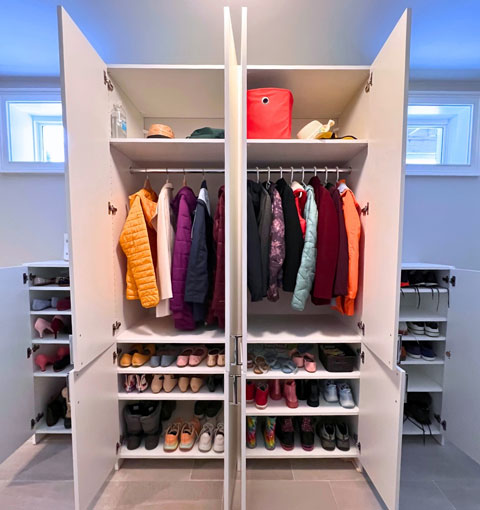
A well-designed closet isn’t simply a place to store belongings. It’s a system that supports your daily routine, reduces unnecessary decisions, saves time, and makes staying organized easier over the long term.
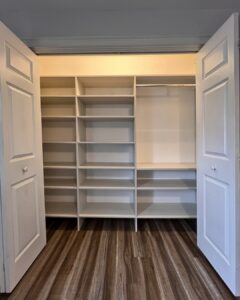 The result isn’t perfection. It’s less stress.
Whether you’re getting kids ready for school, preparing for work, or simply trying to make your evenings a little calmer, intentional organization removes small obstacles that quietly consume your time and energy.
That’s why investing in thoughtful design isn’t just about improving a room—it’s about improving the experience of living in your home.
Beautiful spaces are wonderful.
But spaces that are designed around the way you actually live? Those are the ones that make a lasting difference.
McMains, S., & Kastner, S. (2011). Interactions of top-down and bottom-up mechanisms in human visual cortex. Journal of Neuroscience, 31(2), 587–597.
Rubin, G. (2019). Outer Order, Inner Calm: Declutter and Organize to Make More Room for Happiness. Harmony Books.